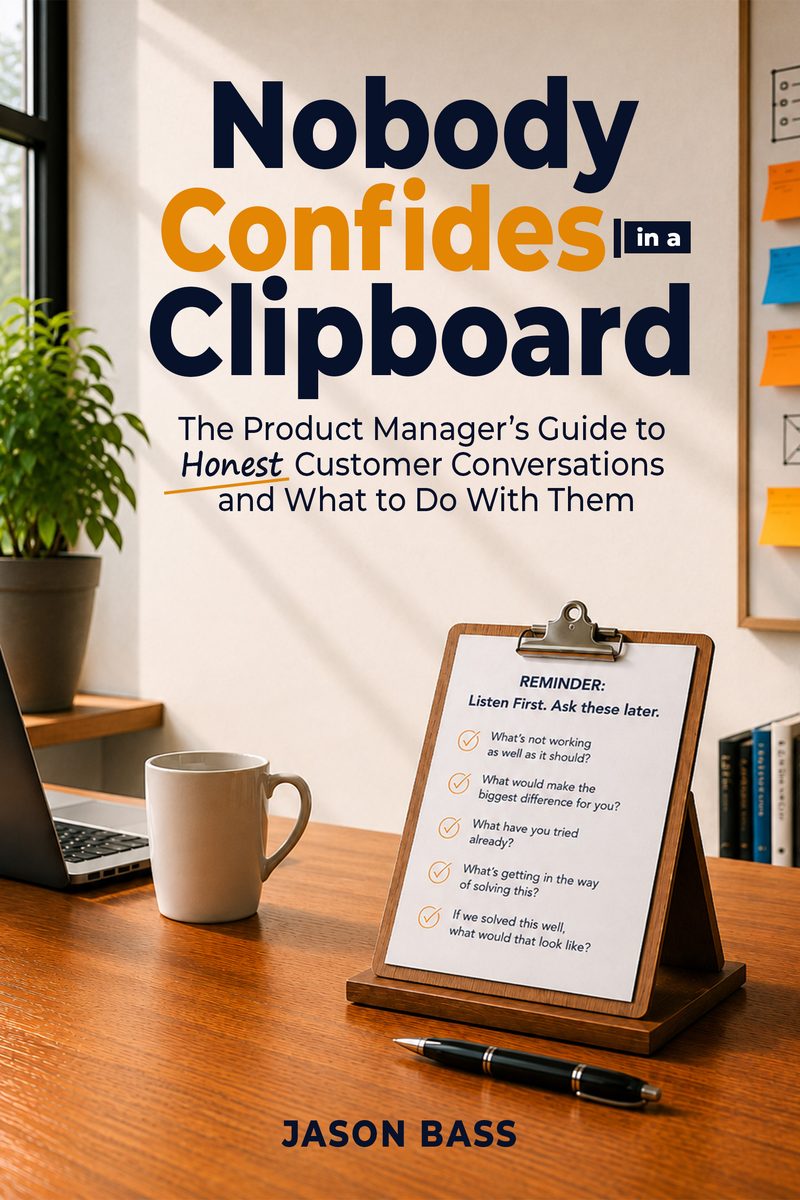
The book
Nobody Confides in a Clipboard
The Product Manager's Guide to Honest Customer Conversations and What to Do With Them
By Jason Bass
Available now on Amazon.
Hand someone a list of pre-planned questions and you get pre-planned answers. Polite, tidy, and rarely the truth.
People open up when the conversation is honest and unhurried, when you're curious enough to set the script aside and follow what they say, not what you hoped to hear. Nobody Confides in a Clipboard is a practical guide for the product managers, founders, and leaders who want their roadmaps built on what customers really need, not the loudest opinion in the room.
It draws on real conversations, a fair share of mistakes, and the lessons of carrying the customer's voice into every department: product, sales, marketing, and the executive table. And it's the same working-backwards approach behind every engagement on this site, written down.
It starts with Shelly
Shelly is a school librarian and a long-time customer. Jason flew out to ask for her feedback on a shiny new product idea. Before he could show her a single slide, she told him something that reorganized how he understood his whole job:
“Your search makes my students feel stupid.”
The fix she was asking for had been sitting in the backlog for months, ranked medium priority and outargued by louder voices, because no real customer had ever been in the room to say what it cost them. Her five words did what a year of roadmap process couldn't. The book is about how to earn sentences like that, and what to do with them once you have them.
What's inside
- Introduction
Why I Wrote This Book
From frustrated salesperson to product leader, and why the human part of the job matters more, not less, in the age of AI.
- Chapter 1
Shelly's Problem
A five-word customer insight that outranked a year of roadmap process, and the idea of carrying one quote into every room.
- Chapter 2
Nobody Confides in a Clipboard
Why polite answers are the enemy, and how humility, honesty, and humor get people to tell you the truth.
- Chapter 3
The First Answer Is Only the Beginning
Taking customers to a specific moment, the five-second silence, following their energy, and catching the sentence that matters.
- Chapter 4
What Are We Actually Solving?
Turning feature requests, including your own favorite idea, into a clearly defined problem using five Working Backwards questions.
- Chapter 5
The Customer in Every Room
How one customer-voice document aligns engineering, marketing, sales, and design around the same real person.
- Chapter 6
The Quote on the Page
Writing business cases leaders trust: hunting down weasel words and pairing customer quotes with hard data.
- Chapter 7
Make the Rep Look Good
Ending the sales-versus-product feud by listening first and closing the loop in the customer's own words.
- Chapter 8
The Shelly Thing
Why engineers, and every other team, do better work when you hand them a person instead of a ticket.
- Chapter 9
Take It Back to Shelly
Prototypes as questions, matching fidelity to the maturity of the idea, and defining “done” in the customer's words.
- Chapter 10
The Next Shelly
Why launch is the starting gun: pairing dashboards with conversations and resisting the quiet drift of success.
Every chapter includes
Two things to try this week
Practical actions, not concepts, so you can put each chapter to work in your very next customer conversation.
Where the machine helps
Ready-to-use AI prompts that help you prepare, synthesize, and write, with clear guardrails so the machine never stands in for the customer.
Written for the age of AI
In the age of AI, honest customer conversations matter more, not less. A machine can summarize a thousand reviews before your coffee is cold, but it can't earn a guarded person's trust or catch the five words that change everything. AI amplifies a real customer's voice; it can't manufacture one.
So the book shows you how to put AI to work on the right side of that line. Every chapter includes concrete tools and ready-to-use prompts for turning real customer conversations into sharper decisions, without letting the machine stand in for the person. Used well, AI becomes the best assistant a product manager has ever had.
Who it's for
- Product managers, especially early in their careers, who want their roadmaps built on what customers really need.
- Founders who need the truth about their market before they spend to build.
- Product and team leaders who want customer insight to be a team habit, not one person's job.
- Product marketers, UX researchers, and anyone in sales or customer success who carries the customer's voice into the room.
If you lead a product team, it's one to share with them. Everyone gets sharper when the whole team listens the same way.
About the author

Jason Bass
Jason started his career in sales, then moved into product for one reason: he wanted the customer's voice in every room, not just on a slide. Across more than twenty years and over ten thousand hours of customer conversations, in product, sales, marketing, and executive teams at Amazon, Wiley, Gale, and Edmentum, he kept arriving at the same place: the best products come from listening well and having the courage to act on what you hear.
He is the founder of Customer Centric Innovations, where he helps product teams build from the customer out through facilitated product work and leadership coaching. Connect on LinkedIn.
Common questions
Is this a book about running customer interviews?
Partly. It covers how to hold conversations where people tell you the truth, but it goes further: what to do with what you hear, and how to carry it into the decisions your organization makes.
Do I need to be a product manager to get value from it?
No. It's written for product managers first, but founders, product marketers, researchers, and leaders who work with customers use the same skills.
Is it about AI?
AI runs through it, but it isn't the subject. The book argues that AI can amplify a real customer's voice but can't manufacture one, and it gives you practical prompts for using AI to make the work faster without replacing the conversation.
Can Jason work with my team on this?
Yes. The book's approach is the foundation of every CCI engagement, from vision sprints to prototype validation. Start a conversation.
Bring this approach to your team
The book is the method. CCI engagements put it to work with your team, on your customers and your product, so the habits stick after we leave.
Start a conversationWays to work together
- Product Vision SprintProduct Management
- From Vision to PrototypeProduct Management
- Backlog to RoadmapProduct Management
- Leading with AuthenticityLeadership Coaching